Before I’d even stepped through the door, Jill’s Tuppaware Party had already caught my attention. It has one of the best posters I’ve seen at the Fringe this year: gloriously camp, colourful, beautifully styled and with just enough of a sinister edge to suggest that something rather strange might be lurking underneath all that suburban perfection.
Of course, a great poster can sometimes be dangerous. You occasionally arrive at a show having already fallen in love with the artwork, only to discover that the production itself is nowhere near as interesting as the image being used to sell it.
Thankfully, that absolutely isn’t the case here.
From the moment you arrive, the experience has already begun.
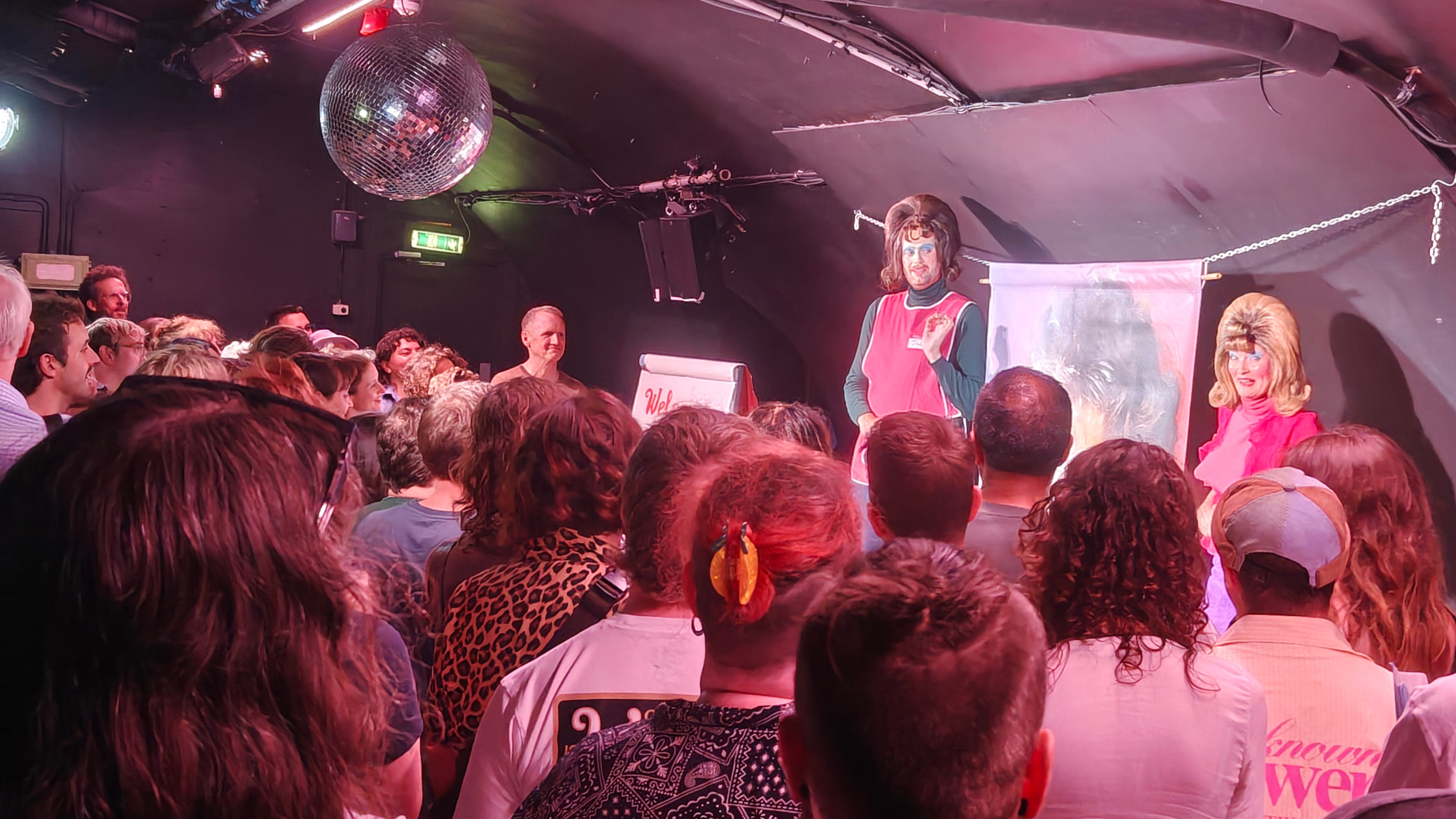
One of our immaculately presented hosts greets us and hands each audience member what looks like a little party goodie bag. Inside is a name badge.
Mine says Jill.
So does everyone else’s. No one is complaining.
Welcome to Jill’s Tuppaware Party, where apparently everyone is called Jill.
There are several other things hidden inside the bag, but I’m deliberately not going to reveal too much. This is one of those shows where going in without knowing exactly what is about to happen makes the whole experience considerably more fun.
We’re ushered into the party and encouraged to mingle with the other Jills. On the performance I attended, the show was completely full, and within a few minutes an entire room of strangers abuzz with chat.
One of the little items we are given contains a unique cracker size question that you can use to break the ice with another audience member. It’s such a simple idea, but it works brilliantly. Rather than sitting quietly waiting for something to start, we’ve already entered the world of the show before we’ve really realised it.
Imagine The Stepford Wives, a 1970s housewives’ Tupperware party and Avon ladies and the faint whiff of a horror film all being put through an extremely camp blender.
That gets you somewhere close.
Everything is smiles, enthusiasm and determined positivity.
Everybody is Jill.
And, naturally, we’re here to sell Tuppaware.
Forget Avon ladies knocking at the door or Jehovah’s Witnesses arriving unexpectedly on a Sunday morning. These women are serious about plastic storage.
During the party we begin to learn more about a mysterious new top-secret product. Again, I’m keeping quiet about exactly what happens because revealing too much would completely spoil the pleasure of the show.
What I can say is that the production understands exactly how to build its atmosphere.
It begins as something beautifully silly and kitsch. You laugh at the ridiculousness of the situation, you meet the other Jills, you join in with the patter and gradually become part of this strange little community.
Then things begin to develop.
There’s a proper narrative arc here rather than simply an hour of audience games dressed up as a Tupperware party. The story builds, the characters become increasingly fascinating and the world around you starts to feel just a little bit stranger.
That slight sense of unease underneath all the smiles is what makes it particularly delicious.
Audience participation can be a dangerous thing. There are shows where you spend the entire hour terrified that someone is about to drag you onto a stage and make you do something humiliating. This isn’t one of them.
You’re encouraged to participate, but there is enough freedom to decide how involved you want to become. What is particularly clever is that the audience interaction isn’t simply bolted onto the show for laughs — it actually helps create the world.
By the time things really get going, the audience isn’t watching Jill’s Tuppaware Party.
We are Jill’s Tuppaware Party.
That distinction makes all the difference.
I also found myself thinking about the poor Avon ladies of the 1970s and 80s who must have attended endless monthly meetings filled with sales targets, motivational speeches and relentlessly fixed smiles. There’s something very funny about taking that world of direct selling and pushing it into this heightened, absurd universe.
The two performers maintain that peculiar tone brilliantly. It’s camp without becoming lazy camp, silly without becoming meaningless, and there’s always that suggestion that something slightly darker is happening underneath.
The audience response on the night I attended said everything.
People were smiling constantly. Strangers were chatting to each other. Everyone seemed completely prepared to play along with the madness.
And remarkably, I could happily have stayed in this world for another half an hour.
That is probably my biggest criticism: I wanted more.
So many Fringe shows start to feel stretched when they approach the hour mark. This one could genuinely expand its universe further because the concept is strong enough to support it.
It’s also apparently been selling out again and again, and having now seen it, I’m not remotely surprised.
Jill’s Tuppaware Party is inventive, immersive, gloriously kitsch and wonderfully ridiculous, with just enough darkness creeping around the edges.
It is exactly the sort of thing I hope to stumble across at Edinburgh: an idea that sounds completely bonkers on paper, commits fully to its own world and then takes an audience along for the ride.
Do yourself a favour and get a ticket.
You never know.
You might even become the Top Tupp Seller.
And if you do, there is a rather special prize waiting for you. Win it and find out.