I could sense that this production had a real buzz around it from the moment I entered the auditorium. Even for a matinee, the performance was almost sold out, and there was a particular energy in the room—something you could detect from the audience and even from the way the ushers were preparing for the show.
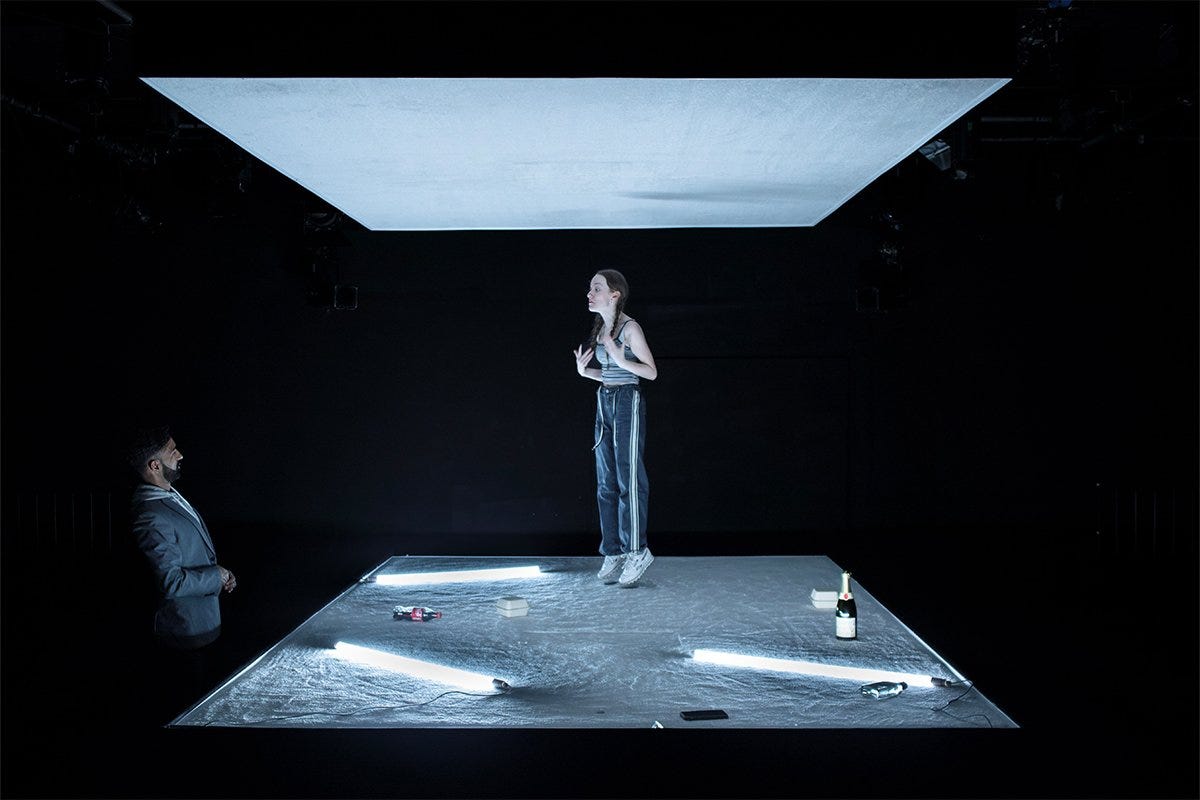
The stage is a simple square, surrounded by seating on three sides. At its centre sits a solitary wheelchair, immediately creating questions about who it belongs to and what has happened.
The play tells the disturbing story of Tia, a young woman who is gradually groomed and drawn into a criminal gang under the pretence of excitement, friendship and parties. Mollie Milne gives a superb performance as Tia, capturing her youth, confusion, vulnerability and growing awareness of the danger surrounding her. Her performance is completely believable, and by the final scenes she pushes the emotional intensity to an extraordinary level.
Taqi Nazeer is frighteningly effective as AJ, the man who grooms her. He is charismatic, persuasive and convincing enough for us to understand how Tia might initially be attracted to him. Rather than presenting him as an obvious monster from the beginning, Nazeer shows us the charm and manipulation that allow someone like AJ to gain control. That makes his performance, and the unfolding situation, all the more disturbing.
Kelise Gordon-Harrison also makes a strong impression as Katie, while the cast move confidently between several other characters. These changes are always clearly defined, so the audience never becomes confused about who is who or where we are within the story.
Phil Davies’s script is exceptionally well written. The events are not presented in a straightforward chronological order; instead, the story emerges through fragments, memories and revelations. Dramatic blackouts divide the scenes, giving the production an almost flashback-like quality as we slowly piece together what has happened.
Marlie Haco’s direction and dramaturgy handle the structure with great skill. The production never becomes sensationalist or exploitative. We are not forced to witness the worst acts committed within the gang. Instead, the play concentrates on the psychological manipulation, the consequences and the way a young person can be seduced into believing that something dangerous is simply a glamorous party or an exciting new group of friends.
Ákos Lustyik’s composition and sound design add enormously to the atmosphere. At times, strange, almost ethereal piano sounds sit beneath the action, heightening the tension without overwhelming it. Ben Jacobs’s lighting design is equally effective, particularly during the sharp blackouts and the later police-station scenes, where the lighting suddenly makes the simple stage appear stark and dramatically transformed.
Tomás Palmer’s set initially appears minimal, but it contains several surprises and is used cleverly throughout the production. Sarah Mercadé’s costume design also helps the performers move convincingly between different characters and environments. The wider creative team includes casting directors Gabriella Shimeld-Fenn and Annelie Powell, production manager Joe Prentice and stage manager Heather Smith.
I completely lost myself in this play. It made me feel anger, fear and frustration, but it also captured the recklessness of youth and the terrible confusion of someone who does not yet understand the seriousness of the situation they have entered.
This is where theatre proves what it can do that television often cannot. You feel as though you are trapped in the room with these characters, watching the danger grow around them. It reminded me slightly of Adolescence, not because the stories are the same, but because both take an intensely difficult subject and allow it to develop in a way that feels immediate, frightening and entirely believable.
This is absolute theatre: urgent, emotionally involving and performed with remarkable conviction.